
SPOR YARALANMALARININ ÖNLENMESİ/MİNİMİZASYONU
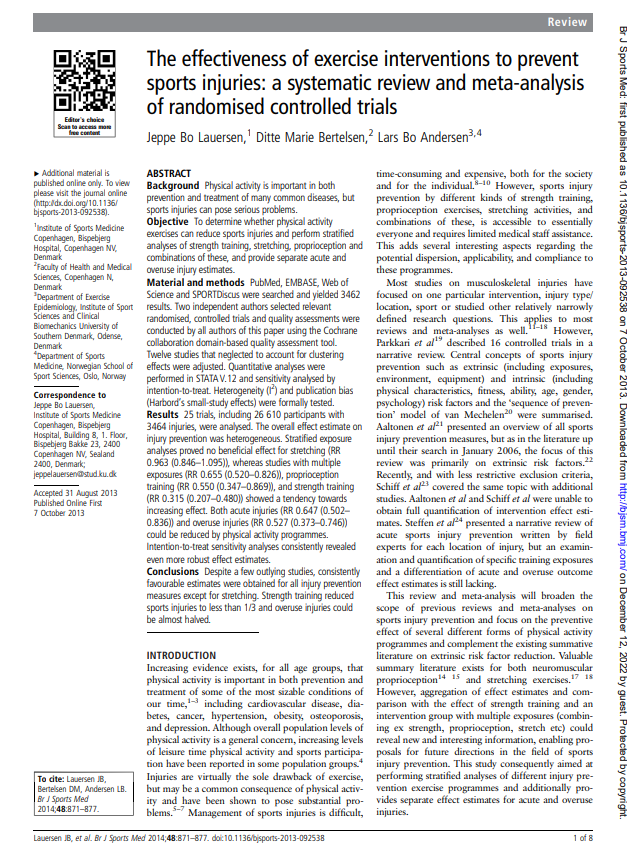
Bu makale; kuvvet antrenmanı, esneme (stretching), propriyosepsiyon ve bu üç egzersiz türünün kombinasyonlarının spor yaralanmalarını önlemedeki etkilerini incelemektedir. British Journal of Sports Medicine (BJSM) dergisinde yayımlanan bir sistematik inceleme ve meta-analize dayanan çalışma, hangi egzersiz seçiminin akut veya aşırı kullanım (overuse) yaralanmalarını azaltabileceğini belirlemeyi amaçlamaktadır.
Rekreasyonel amaçlı egzersiz yapanlardan profesyonel sporculara kadar tüm gruplarda aktivite yaralanmaları her zaman endişe kaynağı olmuş ve bu yaralanmaların önlenmesi için pek çok araştırma yapılmıştır. Sakatlanmalar, büyük olasılıkla fiziksel aktivitenin tek olumsuz yanıdır. Bilhassa spor branşlarındaki yaralanmaların önüne geçmek amacıyla çok çeşitli egzersiz türleri uygulanmakta veya denenmektedir. Hatta bu egzersizlerin haftanın hangi günü uygulandığı dahi yaralanma riskleri üzerinde etkilidir. Kimi zaman birden fazla egzersiz türünün kombinasyonu tercih edilmekte ve bu programların, psikolojik etkileriyle birlikte yaralanmaları önlemede fayda sağladığı düşünülmektedir.
Bu sistematik inceleme için PubMed, EMBASE, Web of Science ve SPORTDiscus elektronik veri tabanları tarandı ve 90 başlık veren 3462 sonuç elde edildi. Geçmiş tarih kısıtlaması olmadan Ekim 2012’ye kadar literatür taraması yapıldı ve dahil etme ve hariç tutma kriterleri sonucunda 40 tanesi tam metin olarak tarandı. Referans listelerinin incelenmesi sonrası arama tarihinin sınırı Ocak 2013’e güncellendi. Dahil edilen tüm çalışmalar Cochrane tarafından önerilen “alan tabanlı değerlendirme” aracı kullanılarak değerlendirildi. 2 hakem (Jeppe Bo Lauersen & Ditte Marie Bertelsen) tarafından çalışmalar gözden geçirildi. 2 Hakem raporlamada yetersiz kalır ya da net olamazsa, üçüncü bir hakem (Lars Bo Andersen), aşırı olumlu raporlama riskini azaltmak için belirlendi.
Çalışmaya İngilizce kaynaklı çalışmalar, randomize kontrollü denemeler dahil edilirken, hakemli yayınları içeren çalışmalar da çalışmaya dahil edildi. Yaralanmaların çalışmaya dahil edilmesi için, yaralanmaların ya spor sırasında ya da fiziksel aktivite sırasında gerçekleşmesi gerekiyordu. Yalnızca insanlar üzerinde araştırma yapılan çalışmalar bu meta analize dahil edildi.
Çalışmaya, farklı yaralanma önlemleri, herhangi bir (kinezyo bant veya tabanlık) terapötik önlem ve yetersiz takip içeren çalışmalar dahil edilmedi. Kişiyi etkileyebilecek herhangi bir patolojiyi içeren çalışmalar da çalışmaya dahil edilmedi.
Genel kanının aksine esneme/germe yaralanmaların üzerinde herhangi bir koruyucu etki göstermezken (RR=0,961), kuvvet antrenmanı oldukça anlamlı bir etki gösterdi (RR=0,315). Propriyosepsiyon eğitimi (RR=0,480) ve bu egzersiz türlerinin kombinasyonları da (RR=0,625) yaralanmalar üzerinde anlamlı veya etkiliydi. Ancak sonuçlar heterojendi.

Egzersizden önce veya sonra yaralanmayı önleme/minimize etme amacıyla esneme/germe desteklenmemektedir (Bu görüş, yalnızca askerlerle ilgili iki çalışmaya ve genel popülasyonla ilgili internet tabanlı bir çalışmaya dayanmaktadır.) Germe ve kuvvet antrenmanı çalışmalarından elde edilen sonuçlar farklı egzersiz programları kullanılmasına ve ilgili sonuçların farkına rağmen sonuç heterojen değildi. Yani, birbiriyle aynı nitelikleri taşımayan egzersiz programlarına rağmen sonuç bir bütünlüğü işaret ediyordu. Dolayısıyla bu sonuçlar, güçlü bir genellenebilirlik göstermektedir. Her ne kadar sonuçlar özellikle kuvvet antrenmanı için oldukça önemli ve faydalı gözüksede, sonuçlar kuvvet antrenmanının büyük spor yaralanmalarını önleme/minimize etme üzerine olduğundan daha geniş bir yaralanma yelpazesi için kuvvet antrenmanı üzerine daha fazla araştırmaya ihtiyaç vardır. Sonuçlar sınıflandırıldığında önleyici fiziksel aktiviteler akut yaralanmalar üzerinde (RR=0,615) daha etkisiz, aşırı kullanım yaralanmalar üzerinde (RR=0,527) daha etkili sonuçlar gösterdi.
1. Strong WB, Malina RM, Blimkie CJ, et al. Evidence based physical activity for school-age youth. J Pediatr 2005;146:732–7.
2. Warburton DE, Nicol CW, Bredin SS. Health benefits of physical activity: the evidence. CMAJ 2006;174:801–9.
3. Nelson ME, Rejeski WJ, Blair SN, et al. Physical activity and public health in older adults: recommendation from the American College of Sports Medicine and the American Heart Association. Med Sci Sports Exerc 2007;39:1435–45.
4. Knuth AG, Hallal PC. Temporal trends in physical activity: a systematic review. J Phys Act Health 2009;6:548–59.
5. Blair S, Franks A, Shelton D, et al. Chapter 4—the effects of physical activity on health and disease in physical activity and health—a report of the surgeon general. U.S. Department of Health and Human Services, Centers for Disease Control and Prevention, 1996.
6. Janda DH. Sports injury surveillance has everything to do with sports medicine. Sports Med 1997;24:169–71.
7. Campbell K, Foster-Schubert K, Xiao L, et al. Injuries in sedentary individuals enrolled in a 12-month, randomized, controlled, exercise trial. J Phys Act Health 2012;9:198–207.
8. De Loes M. Medical treatment and costs of sports-related injuries in a total population. Int J Sports Med 1990;11:66–72.
9. Khan KM, Thompson AM, Blair SN, et al. Sport and exercise as contributors to the health of nations. Lancet 2012;380:59–64.
10. Smidt N, De Vet HC, Bouter LM, et al. Effectiveness of exercise therapy: a best-evidence summary of systematic reviews. Aust J Physiother 2005;51:71–85.
11. Petersen J, Holmich P. Evidence based prevention of hamstring injuries in sport. Br J Sports Med 2005;39:319–23.
12. Pluim BM, Staal JB, Windler GE, et al. Tennis injuries: occurrence, aetiology, and prevention. Br J Sports Med 2006;40:415–23.
13. Fong DT, Hong Y, Chan LK, et al. A systematic review on ankle injury and ankle sprain in sports. Sports Med 2007;37:73–94.
14. Hubscher M, Zech A, Pfeifer K, et al. Neuromuscular training for sports injury prevention: a systematic review. Med Sci Sports Exerc 2010;42:413–21.
15. Herman K, Barton C, Malliaras P, et al. The effectiveness of neuromuscular warm-up strategies, that require no additional equipment, for preventing lower limb injuries during sports participation: a systematic review. BMC Med 2012;10:75.
16. McBain K, Shrier I, Shultz R, et al. Prevention of sport injury II: a systematic review of clinical science research. Br J Sports Med 2012;46:174–9.
17. Thacker SB, Gilchrist J, Stroup DF, et al. The impact of stretching on sports injury risk: a systematic review of the literature. Med Sci Sports Exerc 2004;36:371–8.
18. Herbert RD, Gabriel M. Effects of stretching before and after exercising on muscle soreness and risk of injury: systematic review. BMJ 2002;325:468.
19. Parkkari J, Kujala UM, Kannus P. Is it possible to prevent sports injuries? Review of controlled clinical trials and recommendations for future work. Sports Med 2001;31:985–95.
20. Van Mechelen W, Hlobil H, Kemper HC. Incidence, severity, aetiology and prevention of sports injuries. A review of concepts. Sports Med 1992;14:82–99.
21. Aaltonen S, Karjalainen H, Heinonen A, et al. Prevention of sports injuries: systematic review of randomized controlled trials. Arch Intern Med 2007;167:1585–92.
22. McBain K, Shrier I, Shultz R, et al. Prevention of sports injury I: a systematic review of applied biomechanics and physiology outcomes research. Br J Sports Med 2012;46:169–73.
23. Schiff MA, Caine DJ, O’Halloran R. Injury prevention in sports. Am J Lifestyle Med 2010;4:42–64.
24. Steffen K, Andersen TE, Krosshaug T, et al. ECSS Position Statement 2009: prevention of acute sports injuries. EJSS 2010;10:223–36.
25. Fuller CW, Ekstrand J, Junge A, et al. Consensus statement on injury definitions and data collection procedures in studies of football (soccer) injuries. Br J Sports Med 2006;40:193–201.
26. Askling C, Karlsson J, Thorstensson A. Hamstring injury occurrence in elite soccer players after preseason strength training with eccentric overload. Scand J Med Sci Sports 2003;13:244–50.
27. Van Beijsterveldt AM, Van de Port IG, Krist MR, et al. Effectiveness of an injury prevention programme for adult male amateur soccer players: a cluster-randomised controlled trial. Br J Sports Med 2012;46:1114–18.
28. Brushoj C, Larsen K, Albrecht-Beste E, et al. Prevention of overuse injuries by a concurrent exercise program in subjects exposed to an increase in training load: a randomized controlled trial of 1020 army recruits. Am J Sports Med 2008;36:663–70.
29. Coppack RJ, Etherington J, Wills AK. The effects of exercise for the prevention of overuse anterior knee pain: a randomized controlled trial. Am J Sports Med 2011;39:940–8.
30. Eils E, Schroter R, Schroder M, et al. Multistation proprioceptive exercise program prevents ankle injuries in basketball. Med Sci Sports Exerc 2010;42:2098–105.
31. Emery CA, Cassidy JD, Klassen TP, et al. Effectiveness of a home-based balance-training program in reducing sports-related injuries among healthy adolescents: a cluster randomized controlled trial. CMAJ 2005;172:749–54.
32. Emery CA, Meeuwisse WH. The effectiveness of a neuromuscular prevention strategy to reduce injuries in youth soccer: a cluster-randomised controlled trial. Br J Sports Med 2010;44:555–62.
33. Emery CA, Rose MS, McAllister JR, et al. A prevention strategy to reduce the incidence of injury in high school basketball: a cluster randomized controlled trial. Clin J Sport Med 2007;17:17–24.
34. Gilchrist J, Mandelbaum BR, Melancon H, et al. A randomized controlled trial to prevent noncontact anterior cruciate ligament injury in female collegiate soccer players. Am J Sports Med 2008;36:1476–83.
35. Heidt RS Jr., Sweeterman LM, Carlonas RL, et al. Avoidance of soccer injuries with preseason conditioning. Am J Sports Med 2000;28:659–62.
36. Holmich P, Larsen K, Krogsgaard K, et al. Exercise program for prevention of groin pain in football players: a cluster-randomized trial. Scand J Med Sci Sports 2010;20:814–21.
37. Jamtvedt G, Herbert RD, Flottorp S, et al. A pragmatic randomised trial of stretching before and after physical activity to prevent injury and soreness. Br J Sports Med 2010;44:1002–9.
38. LaBella CR, Huxford MR, Grissom J, et al. Effect of neuromuscular warm-up on injuries in female soccer and basketball athletes in urban public high schools: cluster randomized controlled trial. Arch Pediatr Adolesc Med 2011;165:1033–40.
39. Longo UG, Loppini M, Berton A, et al. The FIFA 11+ program is effective in preventing injuries in elite male basketball players: a cluster randomized controlled trial. Am J Sports Med 2012;40:996–1005.
40. McGuine TA, Keene JS. The effect of a balance training program on the risk of ankle sprains in high school athletes. Am J Sports Med 2006;34:1103–11.
41. Olsen OE, Myklebust G, Engebretsen L, et al. Exercises to prevent lower limb injuries in youth sports: cluster randomised controlled trial. BMJ 2005;330:449.
42. Pasanen K, Parkkari J, Pasanen M, et al. Neuromuscular training and the risk of leg injuries in female floorball players: cluster randomised controlled study. BMJ 2008;337:a295.
43. Petersen J, Thorborg K, Nielsen MB, et al. Preventive effect of eccentric training on acute hamstring injuries in men’s soccer: a cluster-randomized controlled trial. Am J Sports Med 2011;39:2296–303.
44. Pope R, Herbert R, Kirwan J. Effects of ankle dorsiflexion range and pre-exercise calf muscle stretching on injury risk in Army recruits. Aust J Physiother 1998; 44:165–72.
45. Pope RP, Herbert RD, Kirwan JD, et al. A randomized trial of preexercise stretching for prevention of lower-limb injury. Med Sci Sports Exerc 2000;32:271–7.
46. Soderman K, Werner S, Pietila T, et al. Balance board training: prevention of traumatic injuries of the lower extremities in female soccer players? A prospective randomized intervention study. Knee Surg Sports Traumatol Arthrosc 2000;8:356–63.
47. Soligard T, Myklebust G, Steffen K, et al. Comprehensive warm-up programme to prevent injuries in young female footballers: cluster randomised controlled trial. BMJ 2008;337:a2469.
48. Steffen K, Myklebust G, Olsen OE, et al. Preventing injuries in female youth football—a cluster-randomized controlled trial. Scand J Med Sci Sports 2008;18:605–14.
49. Walden M, Atroshi I, Magnusson H, et al. Prevention of acute knee injuries in adolescent female football players: cluster randomised controlled trial. BMJ 2012;344:e3042.
50. Wedderkopp N, Kaltoft M, Lundgaard B, et al. Prevention of injuries in young female players in European team handball. A prospective intervention study. Scand J Med Sci Sports 1999;9:41–7.
51. Higgins JPT, Green S. eds. Cochrane Handbook for Systematic Reviews of Interventions Version 5.1.0 [updated March 2011].The Cochrane Collaboration, 2011. http://www.cochrane-handbook.org
52. Emery CA. Considering cluster analysis in sport medicine and injury prevention research. Clin J Sport Med 2007;17:211–14.
53. Kerry SM, Bland JM. The intracluster correlation coefficient in cluster randomisation. BMJ 1998;316:1455.
54. Harbord RM, Egger M, Sterne JA. A modified test for small-study effects in meta-analyses of controlled trials with binary endpoints. Stat Med 2006;25:3443–57.
55. Harbord RM, Harris RJ, Sterne JAC. Updated tests for small-study effects in meta-analyses. Stata J 2009;9:197–210.
56. Egger M, Smith GD, Altman DG. Systematic reviews in health care: meta-analysis in context. 2nd edn. London, UK: BMJ Publishing Group, 2008.
57. Braham R, Finch C, McCrory P. Non-participation in sports injury research: why football players choose not to be involved. Br J Sports Med 2004;38:238–9.
58. Finch CF. No longer lost in translation: the art and science of sports injury prevention implementation research. Br J Sports Med 2011;45:1253–7.
59. Keats MR, Emery CA, Finch CF. Are we having fun yet? Fostering adherence to injury preventive exercise recommendations in young athletes. Sports Med 2012;42:175–84.
60. Verhagen EA, Hupperets MD, Finch CF, et al. The impact of adherence on sports injury prevention effect estimates in randomised controlled trials: looking beyond the CONSORT statement. J Sci Med Sport 2011;14:287–92.
61. Soligard T, Nilstad A, Steffen K, et al. Compliance with a comprehensive warm-up programme to prevent injuries in youth football. Br J Sports Med 2010;44:787–93.
62. Juni P, Altman DG, Egger M. Systematic reviews in health care: assessing the quality of controlled clinical trials. BMJ 2001;323:42–6.
63. Moher D, Cook DJ, Eastwood S, et al. Improving the quality of reports of meta-analyses of randomised controlled trials: the QUOROM statement. Quality of Reporting of Meta-analyses. Lancet 1999;354:1896–900.
64. Sterne JA, Gavaghan D, Egger M. Publication and related bias in meta-analysis: power of statistical tests and prevalence in the literature. J Clin Epidemiol 2000;53:1119–29.
65. Egger M, Davey Smith G, Schneider M, et al. Bias in meta-analysis detected by a simple, graphical test. BMJ 1997;315:629–34.